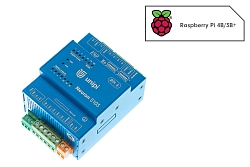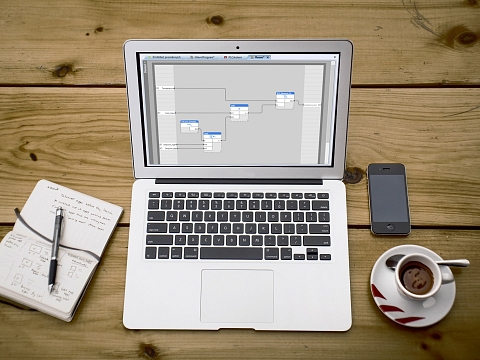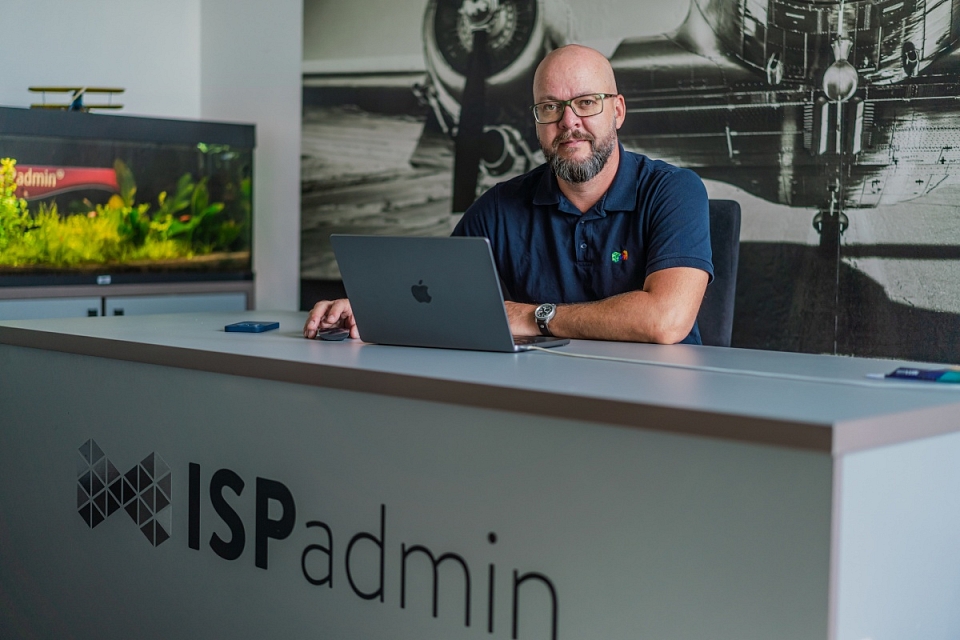
He helps households and businesses to use solar energy efficiently. Dusan Sys started more than 20 years ago as a software programmer for an internet provider. Later, a NET service solution company was formed. Together with his team last year, they developed a complete SolarPilot solution that, in conjunction with the Unipi Neuron S103 controller, controls photovoltaic systems, batteries, and chargers.
What is your view on the development of the PV market?
There was a flurry of construction around 2020 and 2021, with hundreds of plants being built. Everyone with hands and feet was suddenly building roofs, mowing gardens, fixing garages, or installing PV plants. That's what some installations look like today. People were panicking; it was expensive electricity at SPOT, and they paid whatever it cost and didn't care what the companies installed.
Over the last year, people have started to realize that they can't use their PV effectively. Now that electricity is cheaper at SPOT, it makes sense to have smart PV management that will ensure that they optimize their electricity use while also buying and selling it at the appropriate time. Today, we are at a stage where distribution is often more expensive than electricity. People are trying to consume all their electricity at home, which will certainly be a trend.
The other trend that is emerging, with the price of batteries coming down, is the installation of battery storage in companies. I am referring to batteries with a capacity of 40 kWh or more. Two years ago, the price of batteries was two times higher; today, it is starting to pay off, and companies realize this.
Can you introduce the SolarPilot project?
SolarPilot is one of the NET service solution projects. We originally started with the ISPadmin project, which we now have in half of the world. Other projects include FlowPRO for monitoring network traffic or VPNpilot, a complete VPN solution for businesses with two-factor authentication.
About two years ago, I was approached by a friend who works at a photovoltaic company, and he needed some software for PV monitoring and management. My team and I thought it might make sense. Our huge advantage is creating software for more than 20 years. We've tried every wrong way to do it. We created the SolarPilot project in 2023 and are constantly working on and developing it.
I occasionally come across other companies trying to make PV software and going down the wrong path. They have hired inexperienced students and are at the stage where we were 20 years ago. Today, SolarPilot has over 200 large customers in the country. We are always developing new things, and we are in contact with companies that have interesting solutions and projects.
.png)
What is the role of the Unipi Neuron S103 PLC in your project?
We originally started developing our hardware based on the Raspberry Pi. We bought heaps of hardware and tried it from all sides, from right to left. We created our solution, which works, but it's a lot of work and doesn't look professional.
Then we discovered Unipi, the salesman Filip Mekyska gave us a friendly hand, and we started to solve many things together. Unipi was very helpful; thank you for that, both in terms of the overall approach, technical support, and pricing policy. We are now at the stage of selling off the hardware we have, and then we will only use Unipi.
We have customized the hardware for us; everything we needed works perfectly
Unipi is excellent for us; it's certified for industrial use, the device has a pro interface for Modbus, it allows connection of temperature sensors, and it has digital inputs and outputs, which we don't have on the old hardware. It's a big help because it allows us to control the boiler heating and other appliances.
For me, it's stable hardware on a proven Linux platform - we've been working in Linux for over 20 years. The hardware is just fantastic; we've customized it for our needs, and whatever we've needed, it works. I like that Unipi is a Czech company I'm happy to support.
How does Unipi Neuron collect data, and what happens to it?
The Neuron S103 PLC is installed at customers' sites as the main communication platform: it communicates with inverters, batteries, chargers, boilers, and all the devices, collects the data, and packages it up to send to our data center. It doesn't send it to China. Then, the more extensive logic, like calculations, graphing, setup, display, and so on, takes place in the cloud.
What does the controller communicate with the inverter through?
All communication is via RS485 Modbus. We don't communicate with any device through APIs and Chinese clouds because they're unreliable and slow. We need a reliable hardware platform, which Unipi is. It also has a galvanically isolated Modbus, which is great.
We have our own rebranding of SolarPilot, which is cool. When you install it at a customer site, it looks professional. It looks better than our plastic boxes, without question.

Why did you choose the Neuron S103?
We mainly needed a Modbus interface, so RS485 and 1-Wire bus for temperature sensors and digital inputs and outputs. We were looking for the most straightforward and cheapest hardware. It's convenient for us that the unit is DIN rail mountable and fits in the control cabinet.
I was surprised that the hardware is really well made. I really like that, both mechanically, because it's in a metal box and also in terms of certification and the firmware used, where the interfaces are nicely accessible from the command line. They are great to work with, for example, for controlling the LEDs when you need some kind of signaling. It definitely gets thumbs-up from me.
As for the business, it works without any problems via Mr. Mekyska. When we needed to solve technical issues, for example, on Unipi Gate, he connected us directly to the developers, which also worked great.
For me, Unipi hardware is unrivaled in the world. I don't know anyone who develops and manufactures similar hardware with such services. It's compact on a DIN rail, reliable, widely customizable, and built on the Raspberry Pi. It's a big advantage for us to have Linux running on it. It gives us huge library support and flexibility.
Some of our customers were worried about SD card endurance with the S103. Their software was written to wear out the SD card quickly. What's your remedy for that?
That's exactly what I was talking about. We have 20 years of experience, and we've been through a lot. In the past, back when there were no Microtiks, routers for ISPs, we developed our own router on Linux that ran on an SD card. We tested what those SD cards could withstand, and we went the route of not writing anything to the SD card.
All operations are done in memory or on a RAM drive. The basic idea is not to write anything to the disk, preferably nothing at all, then the device is immortal. If you run databases, web servers, applications, grafana, coloring pages, and almost everything, the card will go away quickly.
The data is updated every 20 seconds, and you also send the information to data centers in the Czech Republic. Can you explain the main benefit for the customer?
Since we work for an ISP, we handle security, both for data centers and ISPs, through our software, and we are proficient at it. The fact that everyone today installs a Chinese cloud on every stupid thing, including an inverter, is a road to hell.
For security reasons, when we install a SolarPilot at a customer's site, we often disconnect the Wifi dongle, and the Chinese manufacturer no longer has access to the inverter so that they won't do anything about it. People don't realize what can happen when China sends software that turns it into a brick on your wall. You can't do anything about it anymore; you'll never get it to work.
This is the age we live in: you have an app for every light bulb
If God forbid, Chinese manufacturer starts changing the mains frequency, voltage, and who knows what other parameters. It's all software nowadays. It's a big security gamble, but people don't address it. They want to see an app that displays all kinds of data. It shows them how many tons of CO2 they saved and how many trees they planted. That information is useless. But this is the age we live in: you have an app for every light bulb.
We collect data in 20-second increments; we consider it enough resolution to work with. We can reduce it to 5 or 1 second in certain cases, for example, in power balance services, as required by CEPS (Czech Transmission System Operator), when you start discharging batteries in the event of a power shortage. If there is a surplus of electricity, you begin charging the batteries in a targeted way. This requires a faster read and control interval than 20 seconds.
Our app runs on both the web and phone and is fully responsive. It works on all operating systems, so you don't have to develop a special app just for phones, whether Android or Apple.
We have two data centers in Prague, with complete backup every hour. If one house burns down, the data is in the other. We are now in the process of updating our data center: new hardware arrived at the end of November 2024, which has about five times the performance of what we had before. This has taken us to another level where we are able to handle thousands of units without any problems.
You are not a fan of selling surplus electricity to the grid, can you explain why, and name the benefits of intelligent control for the customer?
Two years ago, the purchase price was 3 CZK per 1kWh. But then it became 2 CZK, a 1,5 CZK, and today someone pays you 1 CZK, so you think that's a great price. Usually, it's 50 cents or nothing.
When you go to SPOT, it makes sense to have intelligent control, which can save you a lot of money. When the price is high, I use the battery. It's good to have prediction so you can tell when to charge the battery, whether to charge it from the sun or the grid. We have integrated weather, so we have that information.
Negative prices over the weekend will eat up the money you save on surplus during the week
Usually, when you switch from the fix, the peak at SPOT is around 8 a.m., when electricity is the most expensive, and then around 7 or 8 p.m. in the evening. So, it's all about beating those expensive peaks on the cheap. Of course, when you're on SPOT, regularly on weekends, there's often a negative electricity price. This year, the record was minus 3 CZK and 40 cents per kWh.
We had a customer who consumes during the week, so he doesn't have much surplus, but he does accumulate some. Over the weekend, he had a surplus at negative prices. He said he got an invoice from CEZ for 2 months of electricity, and it was 1 CZK. This is because what he saved at better prices during the week was eaten up by negative prices over the weekends.
Nowadays, you have 60-100 kWh batteries in your car. It makes sense to time the charging at night when the SPOT price is the lowest. There are really a lot of things to work with on SPOT.
What are your plans for the future?
We want to keep pushing SolarPilot further. Taking on more clients and specializing in corporate customers with larger PV systems certainly makes sense. We built a battery storage facility, and we can manage it intelligently. We have contacts with companies that manage a 400kWh battery storage facility and would like to work with us to manage larger plants where it makes sense to work on SPOT.
Companies that have solutions for residential customers often can't offer more extensive solutions. They can't handle larger inverters, they can't handle higher power, they can't take data from three devices and combine it into one. Our solution is connected to more than 70 different types of inverters, we integrate the communication effortlessly and send all the data to one Czech cloud.
We want to build our solution purely on Unipi because it suits us perfectly. It turns out that customers are willing to pay for quality. For us, the Unipi solution is simple, reliable, looks great, and, most importantly, is professional.