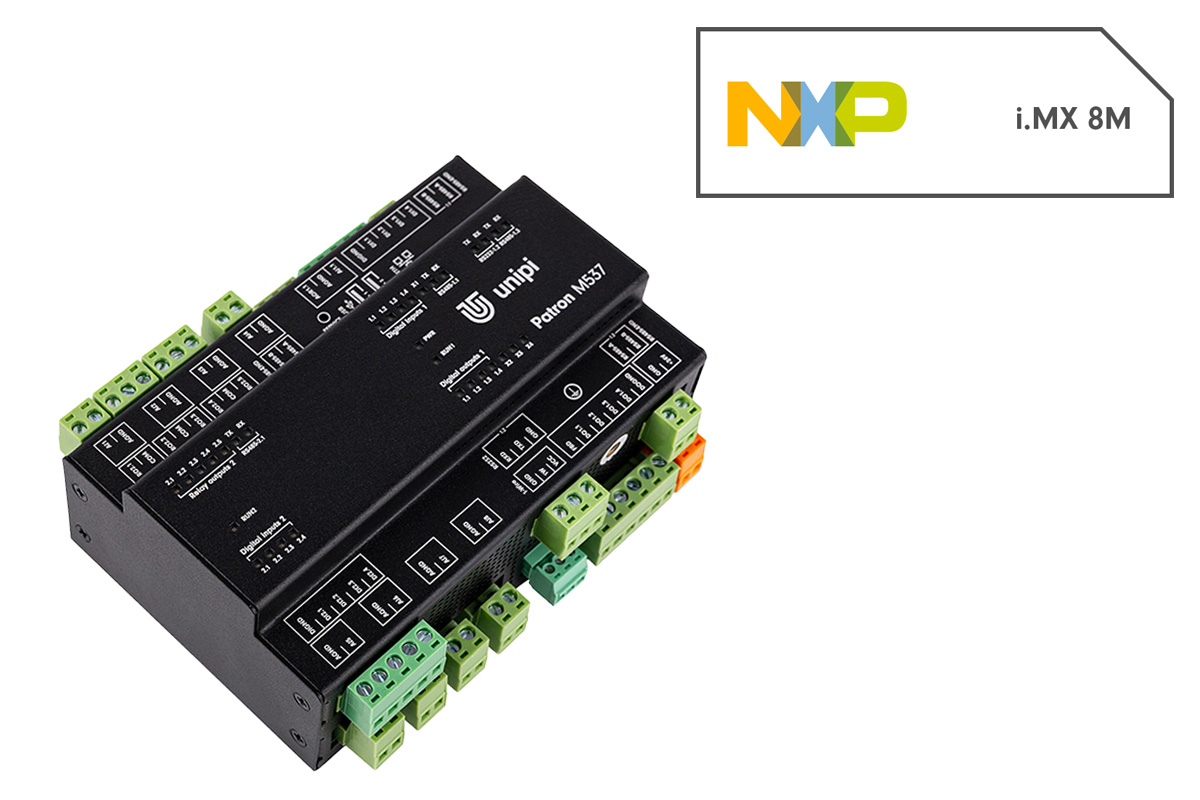
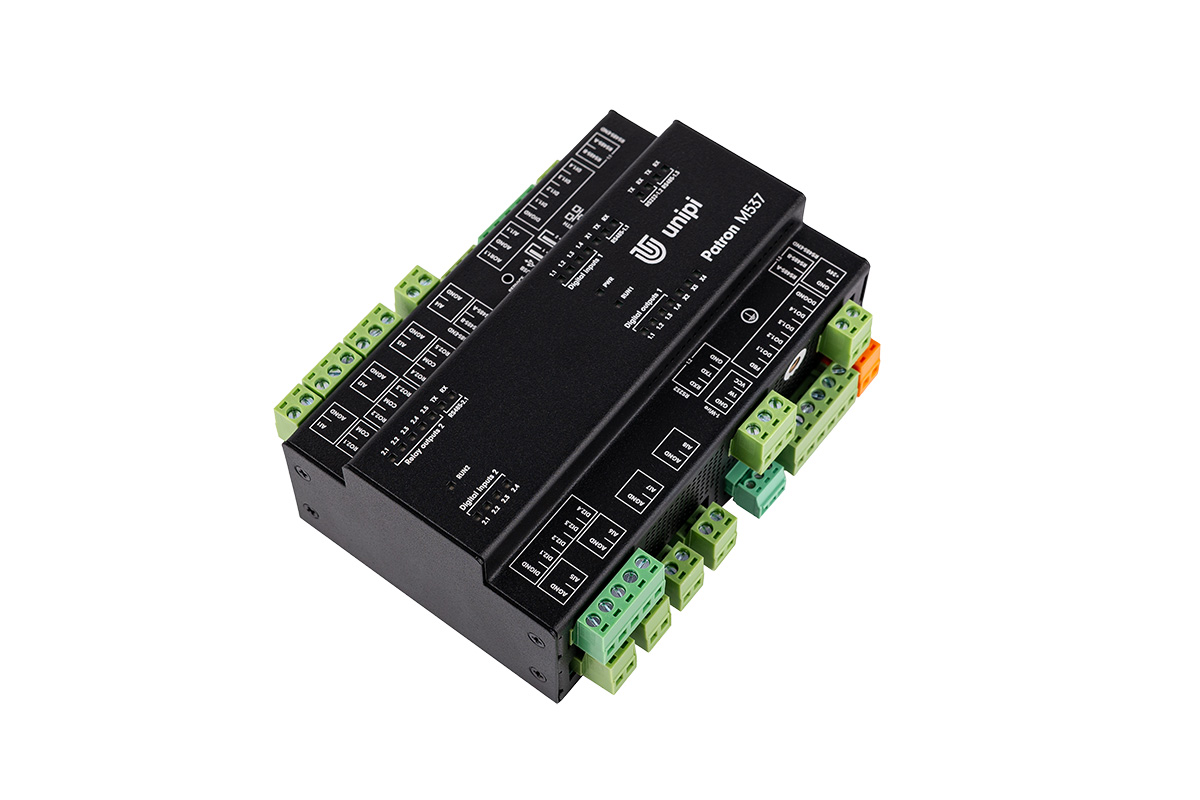
Unipi Patron M537
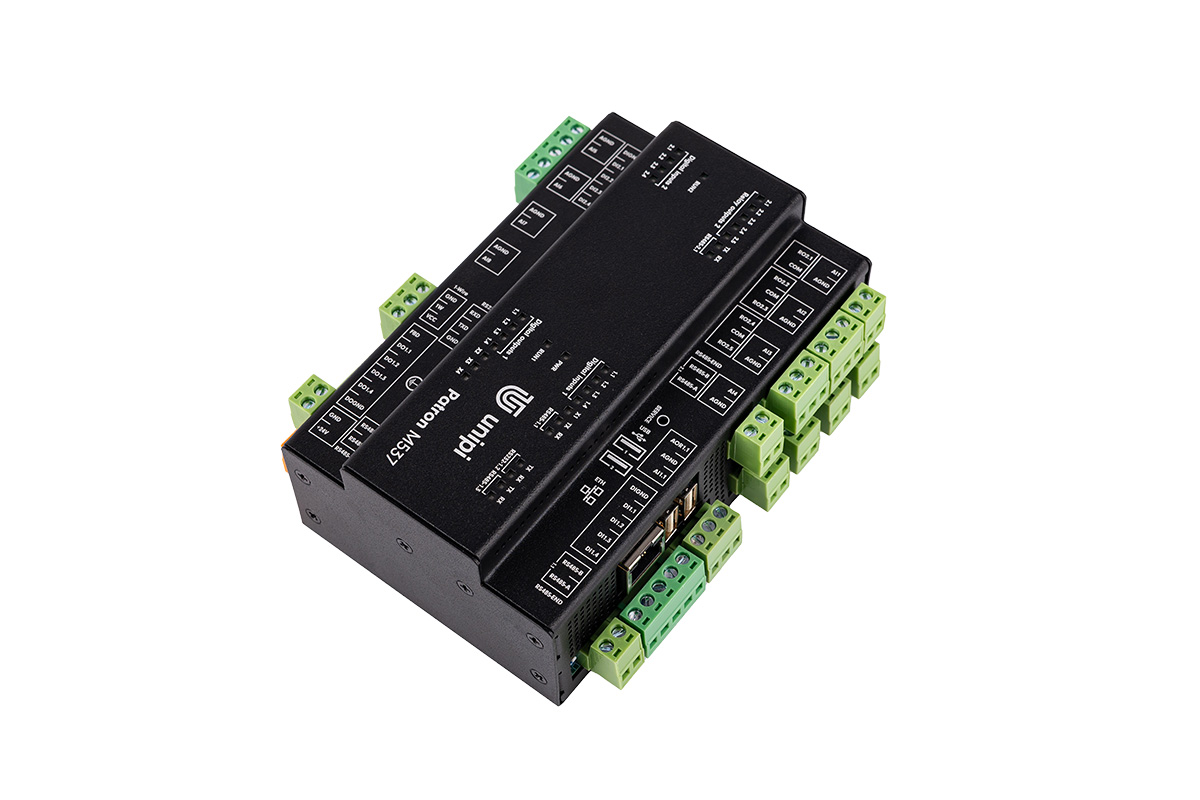
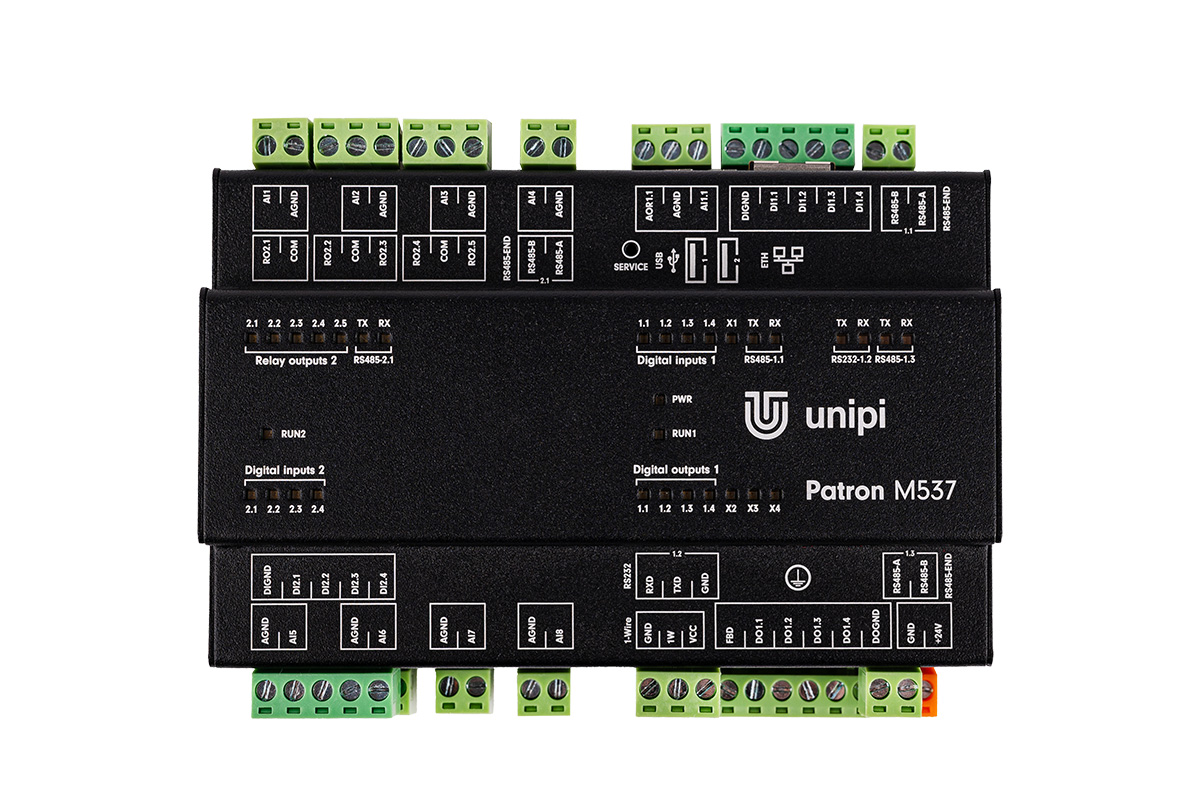
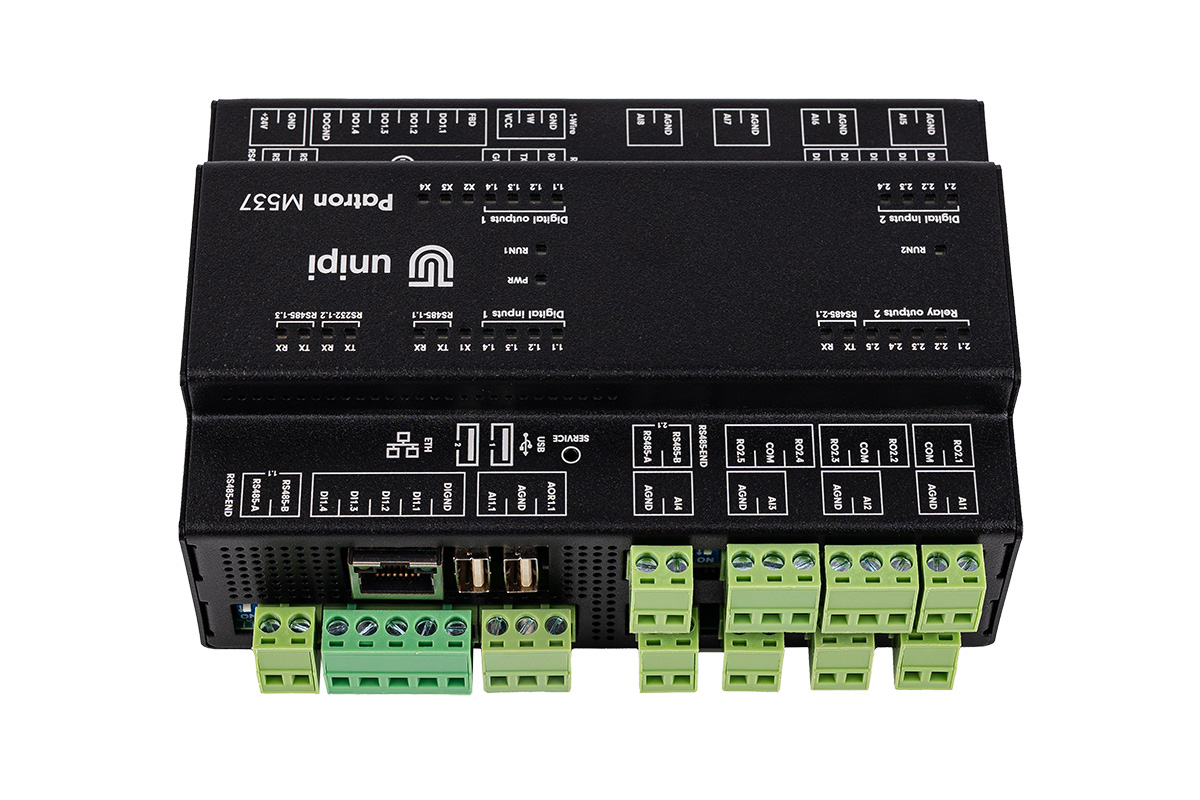
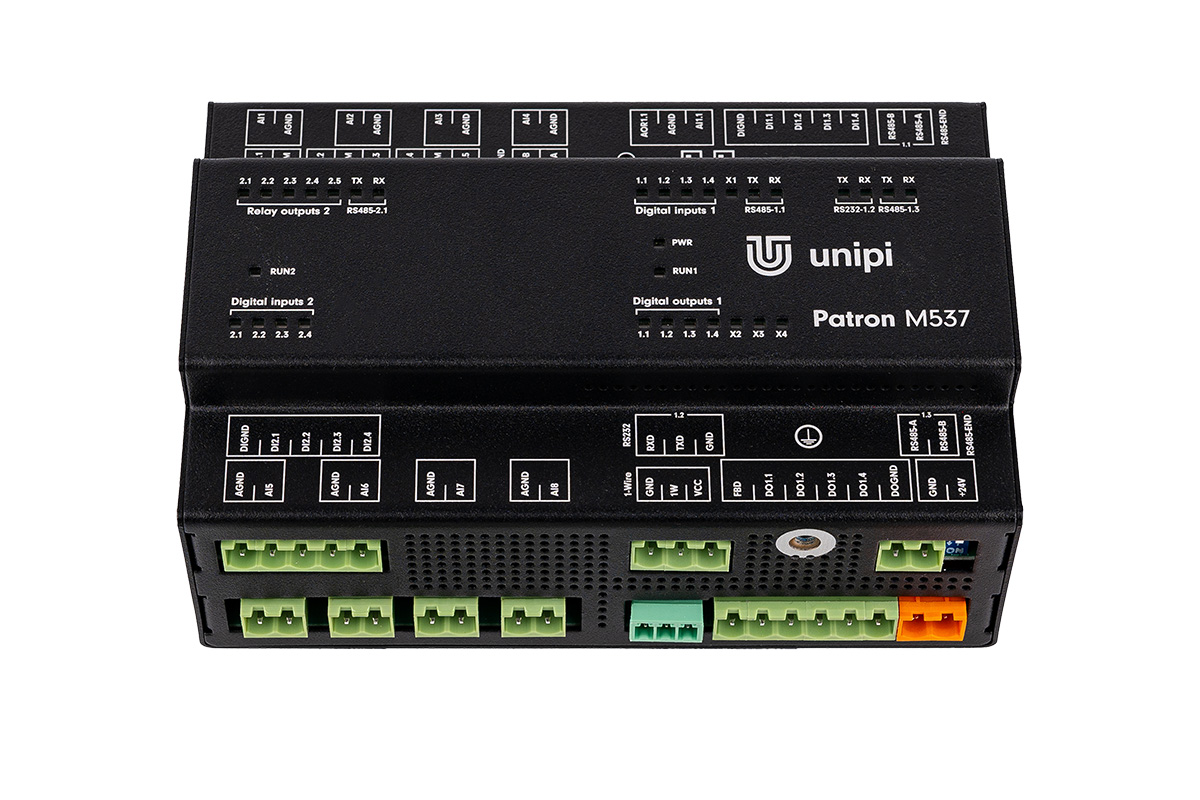
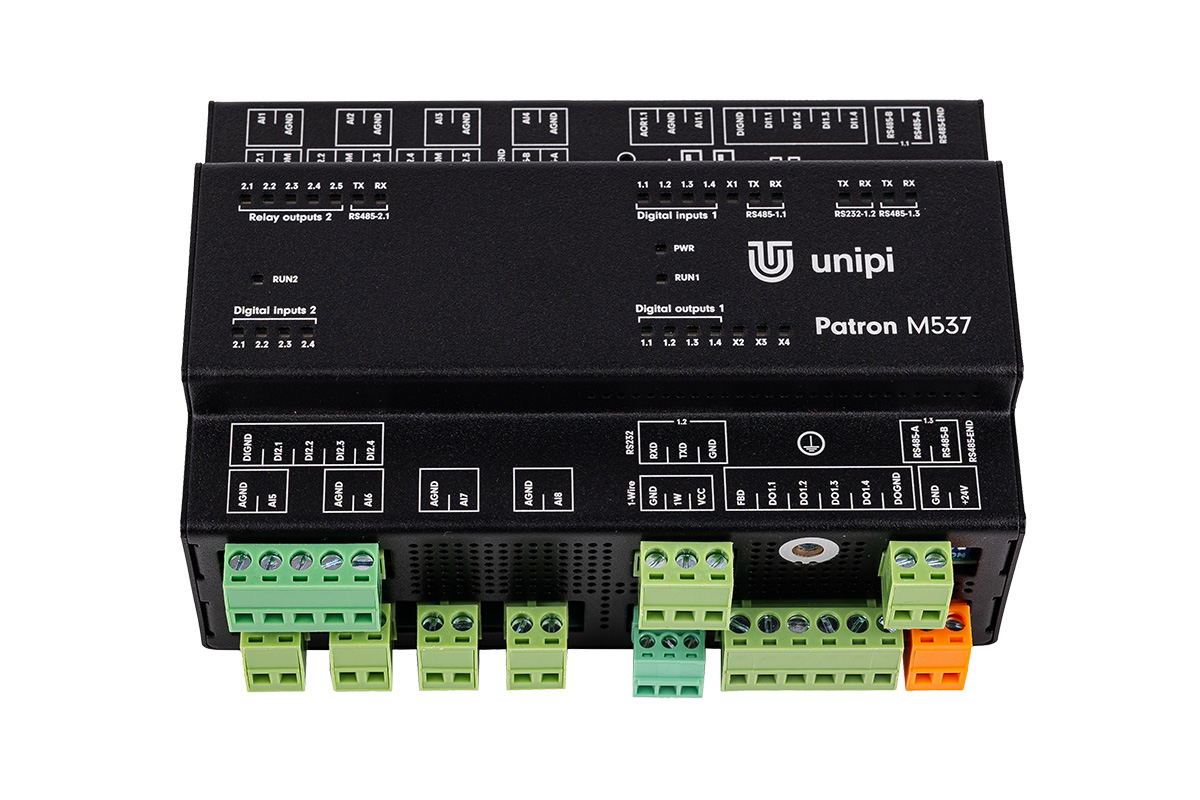
The Unipi Patron M537 programmable logic controller (PLC) and converter is designed for automation, control, regulation and monitoring. The M537's architecture focuses on a higher number of analog inputs. The unit also offers a generous number of digital inputs and relay outputs. That makes it ideal for boiler rooms and other BMS projects, but it works just as well in a much wider range of applications. Four serial interfaces (RS485 and RS232) and a 1-Wire interface for digital temperature and humidity sensors complete its feature set. All Patron controllers come with an extended three-year warranty.
Product description
The Unipi Patron M537 combines a programmable logic controller (PLC) and a converter in one unit, built for automation, control, regulation and monitoring. Its design puts the emphasis on a higher analog input count, and it still has plenty of digital inputs and relay outputs. That makes the M537 a natural fit for boiler rooms and other BMS applications, though it's useful well beyond them. For connectivity it has four serial interfaces (RS485 and RS232) and a 1-Wire bus for digital temperature and humidity sensors. Like every Patron controller, the M537 comes with an extended three-year warranty.
Features
- powered by the NXP i.MX 8M Mini quad-core CPU (Arm© Cortex©-A53, max 1.8 GHz)
- developed and manufactured in the European Union
- internal 8 GB eMMC memory
- universal architecture with a higher number of I/Os
- increased number of analog I/Os, four serial lines (RS485 + RS232)
- durable aluminium chassis (IP20), designed for installation to a DIN rail
- extended 3-year warranty
- software openness (based on Linux OS)
- available in an OEM variant, broad extension options (PoE, Secure boot, wireless technologies, and more)
- pre-installed Mervis system (can be re-installed manually)
- free Mervis software licence
Basic features
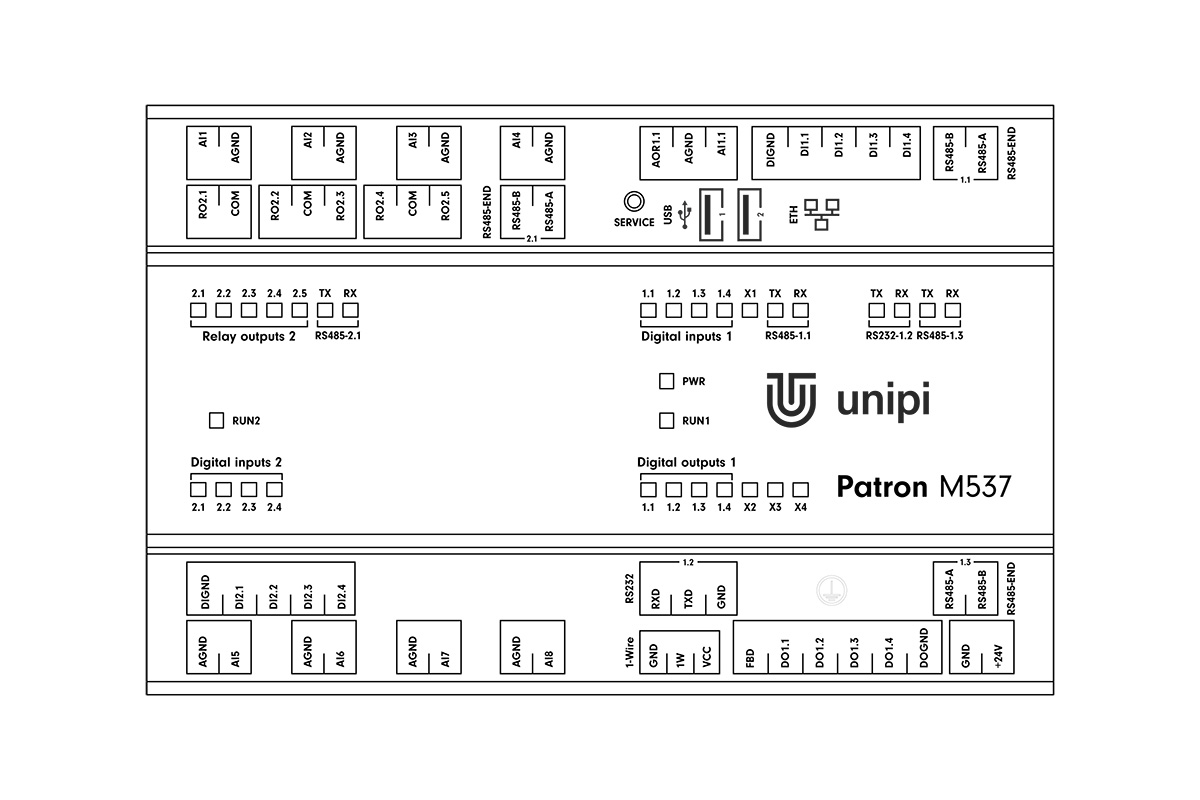
| Digital inputs | 8 | Other features i.MX 8M Mini quad-core CPU (Arm© Cortex©-A53, max 1.8 GHz) 1 GB RAM, 8 GB eMMC onboard memory 2× USB 2.0 100Mbit Ethernet Aluminium chassis (IP20) |
| Digital outputs | 4 | |
| Relay outputs | 5 | |
| Analog inputs* | 9 | |
| Analog outputs (voltage)* | 1 | |
| RS485 interface | 3 | |
| RS232 interface | 1 | |
| 1-Wire bus | 1 | |
| Ethernet | 1 |
*1x AO can be configured for current; more detailed info about the number and type of analogue I/Os is available in the product's datasheet (see the Files tab above)
Inputs & outputs description
Digital inputs (DI) are designed for reading states of two-state devices such as various digital sensors, switches and buttons, motion sensors etc. All digital inputs feature counter functionality by default.
Digital outputs (DO) are applicable for switching two-state devices using direct current (DC) such as locks, external relays, contactors etc. DO’s can be also used for analog control thanks to the pulse-width modulation (PWM) function.
Relay outputs (RO) serve for switching devices with higher current draw and devices requiring alternating current (AC) such as water heaters, pumps, contactors or external relays with higher switching current.
Analog inputs (AI) are designed to measure voltage, current or resistance in order to read values from various analog sensors (pressure meters, thermometers, tension gauges etc.).
Analog outputs (AO) are used to control and regulate devices such as three-way valves, electric motors, inverter drives, heat exchangers etc. by direct current or voltage.
Computing module
Patron controllers are based on the NXP i.MX 8M Mini platform featuring a quad-core ARM Cortex-A53 CPU with 1.8 GHz maximum frequency and 1 GB LPDDR4 RAM. This makes the Patron the most powerful compact PLC available on the market. Internal 8 GB eMMC memory offers higher reliability compared to systems utilizing microSD memory cards.
Communication interfaces
All Patron controllers feature RS485 serial lines by default. This type of interface usually utilizes the Modbus RTU protocol and can be used for communication with various devices such as Extension xS extension modules, energy meters, touchscreen HMI displays, controllers from other vendors, various sensors etc. A single bus can support dozens of devices while its length can reach up to several hundred meters.
Selected models also feature a single RS232 serial line. In the field of automation, this interface is usually used for communication with various converters, closed-in technologies or display devices such as HMI panels.
A single 1-Wire bus is included as a standard feature. This interface uses 2-3 conductors for collecting data from various 1-Wire sensors such as thermometers, humidity meters, light intensity sensors etc. A single 1-Wire bus supports up to 15 devices, the overall length of the bus can reach up to 200 meters.
All Patron controllers also feature a 100 Mbit Ethernet port for network communication.
Software options
Thanks to the software openness of Unipi controllers customers can choose from a broad range of software solutions and are not limited to a single platform. Among supported solutions are both commercial and open-source systems. For a software options overview, please visit this link.
The main supported solution is the Mervis control system - a platform developed under the IEC 61131-3 standard for PLC programming, that includes SCADA interface for remote management and monitoring, a comprehensible development environment, a human-machine interface (HMI) editor and a database for storing historical data and retrospective analysis of the controlled technology's operations. By default, all Patron controllers are shipped with Mervis pre-installed.
Aside from commercial platforms, you can also choose from the list of supported open-source platforms. Alternatively, you can use any of the available APIs provided by the EVOK service (Websocket, REST, …), Modbus TCP or SysFS to implement your logic in any programming language. Visit this link for further info.
Other features
Patron PLCs are developed and manufactured in the European Union. Components are protected by a durable aluminium chassis (IP20 protection). Patron controllers are designed for installation to a standard DIN rail (35 mm), DIN holder and mounting screws are included in the package.
Package contents
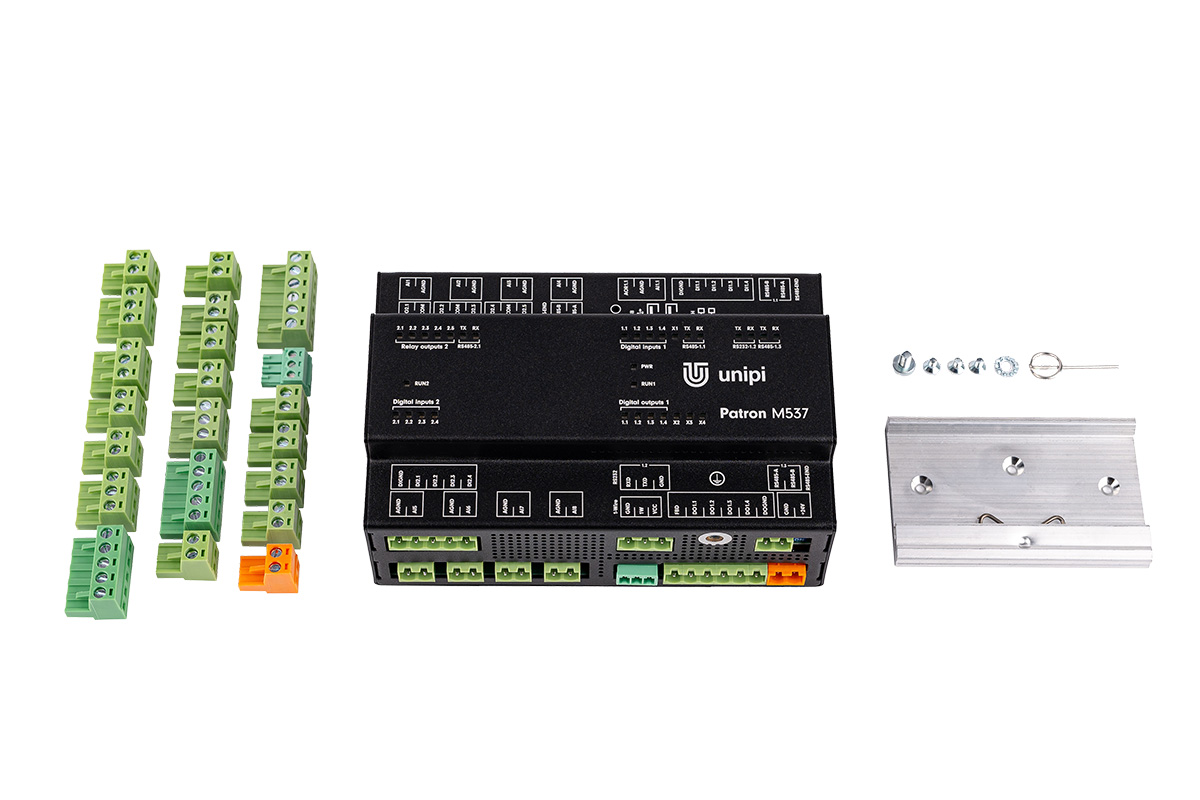
- controller with pre-installed Mervis system (can be re-installed manually),
- removable screw terminals,
- DIN rail holder (35 mm),
- 3× DIN rail holder mounting screw,
- 1× grounding screw with a fan washer,
- instruction leaflet,
- Mervis lifetime licence request.
Patron model overview
| Model | DI | DO | RO | AI | AO | RS485 | RS232 | 1-Wire | Common features |
| Type S, size on DIN rail: 4 modules (7 cm) |
i.MX 8M Mini quad-core CPU |
||||||||
| S107 | 4 | 4 | - | 1 | 1 | 2 | 1 | 1 | |
| S117 | 4 | 4 | - | 1 | 1 | 4 | - | 1 | |
| S167 LTE1 | 4 | 4 | - | 1 | 1 | 2 | - | 1 | |
| S207 | 8 | - | 8 | - | - | 1 | - | 1 | |
| Type M, size on DIN rail: 4 modules (7 cm) | |||||||||
| M207 | 20 | 4 | 14 | 1 | 1 | 2 | 1 | 1 | |
| M267 LTE1 | 20 | 4 | 14 | 1 | 1 | 2 | - | 1 | |
| M527 | 8 | 4 | 5 | 5 | 5 | 3 | 1 | 1 | |
| M537 | 8 | 4 | 5 | 9 | 1 | 3 | 1 | 1 | |
| M567 LTE1 | 8 | 4 | 5 | 5 | 5 | 3 | - | 1 | |
| Type L, size on DIN rail: 4 modules (7 cm) | |||||||||
| L207 | 36 | 4 | 28 | 1 | 1 | 2 | 1 | 1 | |
| L527 | 24 | 4 | 19 | 5 | 5 | 3 | 1 | 1 | |
1) LTE module
Further info
Documentation
|
Certification Declaration of conformity |
download | |
|
Manual User guide and technical documentation |
download | |
|
Instruction leaflet Quick instructions and safety information |
download | |
|
Product datasheet Product features and technical information |
download | |
|
Product leaflet Product line information |
download |
Detailed parameter information and exact I/O specifications can be found in the datasheet.
| Digital inputs | 8 |
| Digital outputs | 4 |
| Relay outputs | 5 |
| Analog inputs | 9 |
| Analog outputs | 1 (voltage/current) |
| CPU | 4× Arm© Cortex©-A53, max 1.8 GHz |
| RAM | 1 GB |
| RS485 interface | 3 |
| RS232 interface | 1 |
| Ethernet | 100 Mbit |
| USB 2.0 | 2× |
| 1-Wire bus | Yes (galvanically isolated) |
| Power | 24 V DC |
| Dimensions | 140 mm × 90 mm × 60 mm |
| Mounting | DIN rail (35 mm) |
| Weight | 362 g |
| RTC backup | Max. 7 days |